Truetone
Truetone 1 Spot Pro CS7 Isolated Pedal Power Supply
Truetone 1 Spot Pro CS7 Isolated Pedal Power Supply
SKU:PTCS7-USJ

Couldn't load pickup availability
The world's first power brick with switching power supply technology.
1 SPOT Pro Features (All Models)
1 SPOT Technology

1 SPOT Technology… what does that mean and why should I care? Technically, it’s switching power supply technology, which is very different than what anyone has ever put inside a power brick. Normally, you would find just a big transformer and a handful of small electronic components inside a power brick… old tech that hasn’t changed in decades and has a lot of limitations. We took the same triple filtered switching power supply technology found in our famous 1 SPOT and scaled it up to make the 1 SPOT Pro models. With much more space to work with, we were able to completely eliminate noise, provide total electrical isolation between outputs, create multiple voltages, and still give you the ability to use it anywhere in the world.
A major benefit of using a switching power supply is that it can handle far more current (power being pulled out of it) than any transformer-based power supply. Although we had to put power rating labels on each output to satisfy certification agencies (yes, we actually certified these, unlike many companies), the outputs can generally handle far more than the label shows. For example, you can connect a 300mA pedal to a 200mA output, without causing any problems. With a transformer-based power supply, you can’t get away with that. The important thing is to not exceed the total of all the labels. With a CS7 (for example), the output labels add up to 1900mA total. That means the total current draw of all your pedals should be less than 1900mA.
Multiple Voltages (CS Series only)
We recognize that not all guitar pedals run off 9V. That’s why all 1 SPOT Pro models have outputs that can put out 9Vdc, 12Vdc or 18Vdc. The CS12 even has a variable voltage output for old-style fuzz pedals, and a 9Vac output for certain Line6 and Digitech pedals. And if you need to change the voltage of an output, Truetone also makes inexpensive converter cables to help you. There’s the Voltage Doubler, which does exactly what its name says, and the 18V to 9V Converter... which also does what its name says. They don’t have the most clever names, but they get the job done!
Worldwide input voltage
Just like with the original 1 SPOT, (and your laptop power supply and phone charger), the 1 SPOT Pro uses switching power supply technology which allows you to use it anywhere in the world.
The 1 SPOT Pro won’t leave you stranded at your first international gig!
Rugged Steel Housing
If you’re a touring musician, or even if you just play at the local pub regularly, you know how important it is to have road-worthy gear. No worries with the 1 SPOT Pro. The housing is all steel, with cleverly designed vents that should keep out the accidental beer spill, should that ever happen.
Pure Isolation
Since pioneering the first switching power supply for musicians, the original 1 SPOT, we’ve gained many years of experience in creating very low noise power for pedals. When we started designing the 1 SPOT Pro, the first multiple output switching power supply, we worried a lot about how to eliminate noise completely. Isolation is part of the solution to noise elimination, but not all of it. Each output is galvanically isolated from the other to help give you pure, clean, noise-free operation of your pedals. However, we also provided an additional layer of pure analog regulation, taking advantage of the greater ability of analog circuits to provide the highest possible suppression of in-band audio noise. There is an artistry involved in these designs, and it’s come at the price of decades of hard work. But all of this put together is what we call Pure Isolation.
Energy Efficient
Prior to the 1 SPOT, musicians either used one linear power supply (a.k.a. wall wart) per pedal, or used batteries. Both solutions for powering pedals were very inefficient with energy, with batteries also contributing greatly to the toxic waste stream. In 2000, we pioneered the use of switching power supply technology to alleviate this condition in an economically-, energy- and environmentally-conservative way. The 1 SPOT power supply was designed to replace many such external power supplies and/or batteries simultaneously. It provided plenty of power with a very low noise level to successfully meet the needs of musicians. By offering musicians a solution that was more cost effective and energy efficient, and moving the market away from linear transformer-based power supplies to switching power supplies, Truetone has caused the saving of thousands of watt-hours per musician per year. Utilizing a more comprehensive switching power supply solution, the 1 SPOT Pro sets a new level of efficiency for power bricks, while still meeting the needs of musicians for low noise operation, even in severe conditions where the pedals themselves may generate interfering noise.
1 SPOT Pro Comparison Chart

| Features | CS6 | CS7 | CS11 | CS12 |
|---|---|---|---|---|
| Total Outputs | 6 | 7 | 11 | 12 |
| Maximum Total Current Output | 1600mA | 1900mA | 3450mA | 3000mA |
| Total 9Vdc Outputs | 6 | 6 | 11 | 9 |
| 9/12Vdc Outputs (switchable) | 2 | 4 | 2 | 4 |
| 9/18Vdc Outputs (switchable) | 2 | - | 2 | - |
| 18Vdc Outputs | - | 1 | - | 2 |
| 9Vac Outputs | - | - | - | 1 |
| Variable 4-9Vdc Outputs | - | - | - | 1 |
| Mounts under Pedaltrain Nano/Metro (flat boards) | ✅ | ❌ | ❌ | ❌ |
| Mounts under Pedaltrain Jr., PT2 and Pro boards | ✅ | ✅ | ✅ | ✅ |
| Comes with Pedaltrain mounting brackets | ❌* | ✅ | ✅ | ✅ |
| Dimensions | 6.3" x 3.46" x 1.2" | 5.5" x 3.37" x 2.0" | 8.07" x 3.38" x 1.97" | 8.12" x 3.37" x 2.0" |
| Weight | 1.3 lbs. | 1.3 lbs. | 2.14 lbs. | 2.35 lbs. |
| Expandable 12V output for XP series | ❌ | ❌ | ✅ | ❌ |
|
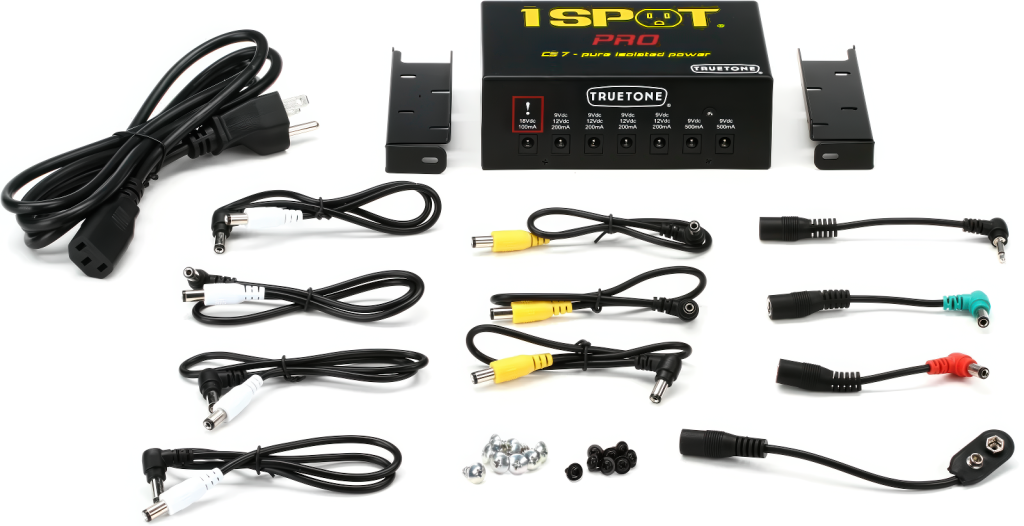
* The low-profile CS6 can mount under almost any pedalboard without using brackets. CS7 SpecsDimensions5.5” x 3.37” x 2” (140 x 86 x 50mm); 1.31 lbs. (592 grams) - weight and dimensions of power supply only, not including cables or packaging. Input VoltageThe 1 SPOT Pro CS7 can be used anywhere in the world without the use of a step-up or step-down transformer. Like our 1 SPOT, it transforms wall voltage from 100-240Vac, and converts it into the stated voltages on the front panel of the unit. Cables
Power cables (all are center pin negative polarity): Converter Plugs: Available Output VoltagesOutput 1: 18VDC (100mA)
Pedaltrain Mounting Brackets
The only power brick to include easy-to-install mounting brackets for Pedaltrain pedalboards. We even duplicated the output labels under the unit, so you can easily see which output is which, when working on your board. Yes, we thought of that too! |
||||


Can the 1 SPOT Pro power my pedal?
That question can best be answered by looking at the following questions and notes…
Which output and settings do I use for my pedals?
It is important for you to know the power requirements for your pedal. For every pedal that you are going to power via the 1 SPOT Pro CS12, you need to know the following:
What is the voltage required by the pedal?
Does the pedal require AC or DC voltage?
What is the polarity of the pedal? (Center pin positive or negative.)
These questions can usually be answered by:
1. Inspecting the pedal itself near the power jack.
2. Referring to the owner’s manual.
3. Checking online, or contacting the manufacturer
4. If your pedal can be powered by a 9Vdc battery, it can be powered by one of the 9Vdc outputs ( an exception being the Boss ACA pedals, see below).
Notes on certain pedals:
- Some older Boss pedals require 12Vdc, yet can be powered by a 9Vdc battery. They will indicate “Use ACA adaptor” near the power jack. To power an ACA pedal please use outputs 2-5, and set to 12Vdc on the dip switch for the corresponding output. Modern Boss pedals will indicate “PSA,” and can be powered by any of the 1 SPOT Pro CS7’s 9Vdc outputs.
- Many germanium based fuzzes and Octavia-style pedals will require the use of the CYR adaptor to reverse the polarity to center pin positive.
- For pedals with high milliamp draws such as Strymon please utilize outputs 6 or 7 that produce 500mA each.
- Eventide pedals such as the Time Factor and H9 may be powered by outputs 6 or 7 with the addition of the CL6 converter, for proper dc jack tip size and polarity.
- Line 6 M5 may be powered by outputs 6 or 7.
- Line 6 M9, and the modeling pedals (DL-4/MM-4), may be powered by outputs 6 or 7, and will also require the CL6 converter.
- Line 6 Tone Core pedals may be powered by any 9Vdc output.
- Line 6 POD or M13 cannot be powered by the 1 SPOT Pro CS7.
- If more 9Vdc pedals need to be powered, a MC5 daisy chain (sold separately) may be plugged into any of the 9Vdc outputs depending on mA draw.
- Pedals that do not utilize a power jack, yet are powered normally by a 9Vdc battery, may utilize any 9Vdc output, along with the CBAT converter.
- TC Electronic Nova pedals may be powered by outputs 2-5 in the 12Vdc position.
- TC Electronic Classic and Tone Print series may be powered by any 9Vdc output.
- Digitech Whammy: Versions 1-4 cannot be powered by the 1 SPOT Pro CS7. Version 5 or Whammy DT may be powered by ouputs 6 or 7.
- Radial Tonebone 15Vdc pedals can be powered by an 18Vdc output, using the Reverse Polarity Converter (CYR) included with the 1 SPOT Pro.